


Silk dress in autumn: how to wear it without getting cold
 Awa14 September 2026

In short: people often think a silk dress is only for warm weather. That is a misunderstanding of the fabric. Silk holds moisture without feeling wet and insulates better than a synthetic fabric of the same thickness: what makes it cool in July makes it comfortable in October, provided you choose the right weave and weight and layer thoughtfully. Here is my method, in four layers and three silhouettes.
September is the month when we put things away too quickly. Ceremonies, dinners that run late, late-season weddings—all of these happen precisely when we store our most beautiful fluid pieces at the back of the wardrobe. I’ve done the opposite for years: my silk dresses get the most wear in fall, and that is also when they feel most right. The light is lower and more golden; it embraces the drape instead of making it shine. The only issue is dealing with the cold, which is a matter of construction, not fabric.
Silk isn’t a summer fabric (and the numbers prove it)
The misunderstanding comes from the feel. Silk is cool to the touch—it conducts heat away from the skin very quickly at first—and people conclude that it constantly cools you down. In reality, its behavior depends above all on how it interacts with moisture.
Under standard textile conditioning, silk’s moisture regain is around 11%, compared with 8.5% for cotton and barely 0.4% for polyester. In practical terms, silk can absorb nearly one-tenth of its weight in water vapor before feeling damp. In fall, when you go from a cool outdoors to a heated interior within minutes, that is exactly the property that matters—the one that prevents the chill caused by a damp lining against your back.
Research on thermoregulatory textiles points in the same direction: a review published in 2025 in Textiles (MDPI) notes that the thermal comfort of a garment worn next to the skin depends less on thickness than on the combined management of heat and water vapor, and ranks silk proteins among the naturally high-performing fibers in this respect. Let’s keep things measured: these studies describe mechanisms; they do not promise that a silk dress can replace a coat. A fluid dress worn on its own at 8°C will be cold, like any other fluid dress. What the fabric tells us is that it deserves to be layered rather than abandoned.
Weave and momme: what really makes the difference in fall
Two “silk” dresses can behave very differently depending on their weave and weight. Momme (MM) measures the weight of silk; the higher it is, the denser, more opaque, and more substantial the fabric. For fall, I always go up a notch compared with summer.
| Weave / weight | Drape | Autumn wear |
|---|---|---|
| Lightweight crêpe de Chine | Fluid, matte, lightweight | Under chunky knitwear, indoors |
| Double-layer georgette | Airy yet opaque | Ceremony: the best unlined option |
| 19 momme mulberry silk | Fluid, satin-like | Dinners, evenings, heated interiors |
| 21–22 momme mulberry silk | Dense, structured | October outdoors, with tights and ankle boots |
| Silk blended with linen | Matte, slightly dry | Daytime, office, weekend |
If these terms seem vague, two Journal articles explain the subject better than I could: Colette details which weave to choose for which garment, and the momme guide explains why this number makes all the difference when buying.
The four layers of a silk dress worn in autumn
My rule: you don’t warm up a silk dress by making it thicker; you warm it up by framing it. Four layers, in this order.
- The underskirt. It’s the layer everyone forgets and the one that changes the most. A silk-blend underskirt adds a layer of air between the skin and the fabric, eliminates the static caused by heating, solves transparency issues in low-angle light, and keeps the dress from clinging to tights. Twenty-nine euros for a piece that makes all the others wearable.
- The knitwear. Cream chunky-rib cardigan, fine cashmere sweater slipped over a long dress to create a waist, or a long open-front cardigan. A contrast in texture—the pronounced rib against the satin—does all the styling work.
- The leg. Sheer nude or dove-gray 20-denier tights for the ceremony, opaque 40-denier tights matching the dress for daytime. Matching tights elongate; contrasting tights cut the line.
- The closed-toe shoe. Suede ankle boots, loafers, closed-toe pumps. Nothing dates a flowing dress faster than sandals in October.
Three silhouettes I’m actually wearing right now
The long dress, for formal occasions. Long dress in mulberry silk or double georgette, belted, underskirt, sheer tights, closed-toe pumps, and a silk stole rolled in your hand for leaving the church. If the dress has thin straps, choose a fine-knit bolero rather than a jacket: the jacket crushes the drape.
The midi, for everyday wear. Printed midi dress, belted V-neck, open cream cardigan, opaque tights, flat ankle boots. It’s the easiest silhouette of the season, and one that takes you from the office to dinner without changing.
The short one, for the weekend. Crêpe de Chine mini dress, fine sweater draped over the shoulders, opaque tights, knee-high boots. The proportion—short with covered legs—is distinctly more autumnal than short with bare legs.
Colours that work this season
Silk takes colour more deeply than most fibres: emerald green becomes almost liquid on it. The colours that work this season are rich, muted shades—burgundy, forest green, midnight blue, plum, terracotta, camel—and, among lighter tones, ivory and champagne, which immediately warm up next to ecru knitwear. Floral prints always work in autumn on one condition: the background must be dark.
Three mistakes to avoid
- A fluid dress over thick underwear. The seams show through. The petticoat, on the other hand, remains invisible.
- The coat that is too short. With a long dress, a mid-thigh coat creates an unflattering break. Long over long, or short over midi.
- Washing it hot after the evening out. Wash cold, by hand or on a silk programme, dry flat, and never use a tumble dryer. A silk dress that is washed incorrectly once loses its drape for good.
Frequently asked questions
Can you wear a silk dress when it’s 12°C?
Yes, with the four layers described above—petticoat, knitwear, tights, and closed shoes. Below 10°C, choose a dense fabric weight (21 momme or more) or silk blended with linen, and add a long coat.
Does silk keep you warm or cool?
Both, depending on the thickness and layering. Its high moisture regain (around 11%) allows it to absorb water vapour without feeling damp, preventing chills after a change in temperature. It is not an insulating fibre like wool: it is a regulating fibre.
What fabric weight for a dress worn in autumn?
19 momme for indoors and evenings, 21 to 22 momme for outdoors. Below 16 momme, the dress remains a summer piece or a layering piece.
Should a silk dress be lined?
Rarely. A sewn-in lining weighs down the drape and cancels out its fluidity. A removable petticoat serves the same purpose and can be washed separately.
Does a silk dress crease a lot when travelling?
Less than linen, more than knitwear. Roll it instead of folding it, and hang it in the bathroom for ten minutes after a shower: the creases will fall out on their own.
For going further
Our silk dresses range from a crêpe de Chine mini dress to a long 21-momme mulberry silk dress, in thirty styles and a wide variety of colours—enough to find one you’ll wear long after the occasion you bought it for. I believe that’s the only real criterion: a silk dress only succeeds if you bring it out again on a Tuesday evening with no special occasion.
Discover StudioSoie silk dresses
— Awa, for the StudioSoie Journal

Lifestyle: gifting, traveling, hosting — silk in everyday life.
Dans le Journal
 Mei
Mei
Pillow marks upon waking: what science really says
 Colette
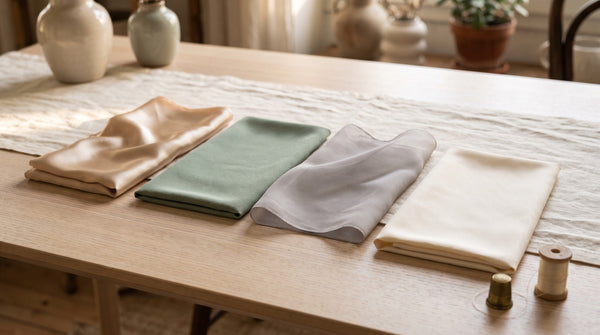
Crêpe de Chine, georgette, silk satin: which weave for which garment?
 Inès
Inès
Back-to-school dust mites and allergies: what silk bedding changes (and what it doesn’t)